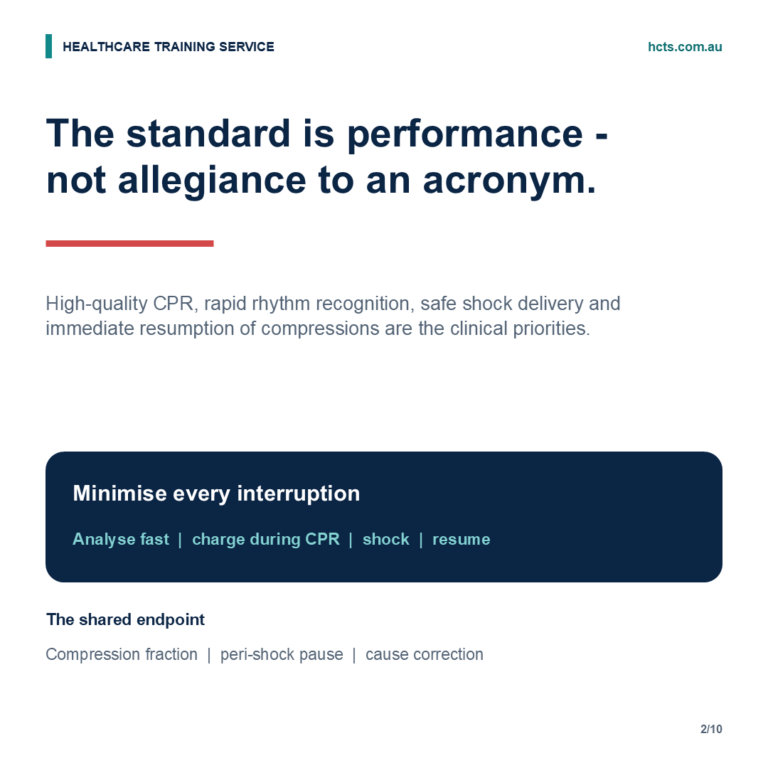
In Advanced Life Support, the quality of defibrillation is determined by accurate rhythm recognition, minimal interruption to CPR, safe shock delivery and immediate resumption of compressions – not allegiance to an acronym.
Defibrillation is critical when ventricular fibrillation or pulseless ventricular tachycardia is present, but a shock is only one component of resuscitation. High-quality CPR must support coronary and cerebral perfusion, the rhythm must be confirmed, and reversible causes must be identified and treated.
Across Australian Advanced Life Support education, anticipatory charging is often taught through the COACHED mnemonic. It is sometimes presented as the only correct contemporary method of manual defibrillation, leaving clinicians taught the conventional analyse-first sequence with the impression that their practice is outdated.
Current evidence and international guidance do not support that level of certainty.
HCTS teaches a conventional analyse-first sequence: pause briefly to assess the rhythm; if VF or pVT is present, immediately resume compressions while the defibrillator charges; clear the patient; deliver the shock; and resume compressions immediately. This sequence does not involve pausing chest compressions while the defibrillator charges. It remains current and guideline-consistent.
Interruptions in chest compressions reduce perfusion. In patients with a shockable out-of-hospital cardiac arrest, longer pre-shock and peri-shock pauses have been associated with lower survival to hospital discharge. The practical objective is therefore to make every necessary interruption as brief as possible without compromising rhythm accuracy or safety.
Any defibrillation sequence should be judged against the same clinical standards:
Clinical implication: Measure what the team achieves – not whether it recites a particular acronym.
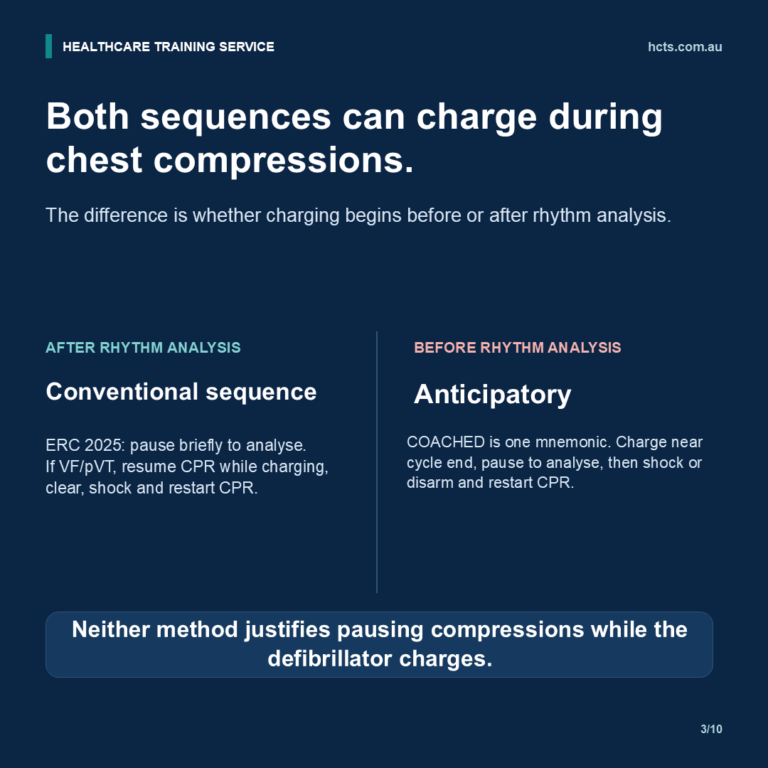
Both the conventional sequence and anticipatory charging can charge the defibrillator while chest compressions continue. The essential difference is whether charging begins after or before rhythm analysis.
Conventional analyse-first sequence
Anticipatory charging sequence
COACHED is one mnemonic used to structure the anticipatory sequence. It is not the sequence itself, and anticipatory charging is not dependent on using that acronym.
Both approaches can minimise no-flow time when performed by a trained team. Neither approach justifies stopping compressions while the defibrillator charges, delaying the rhythm decision, or compromising safety.
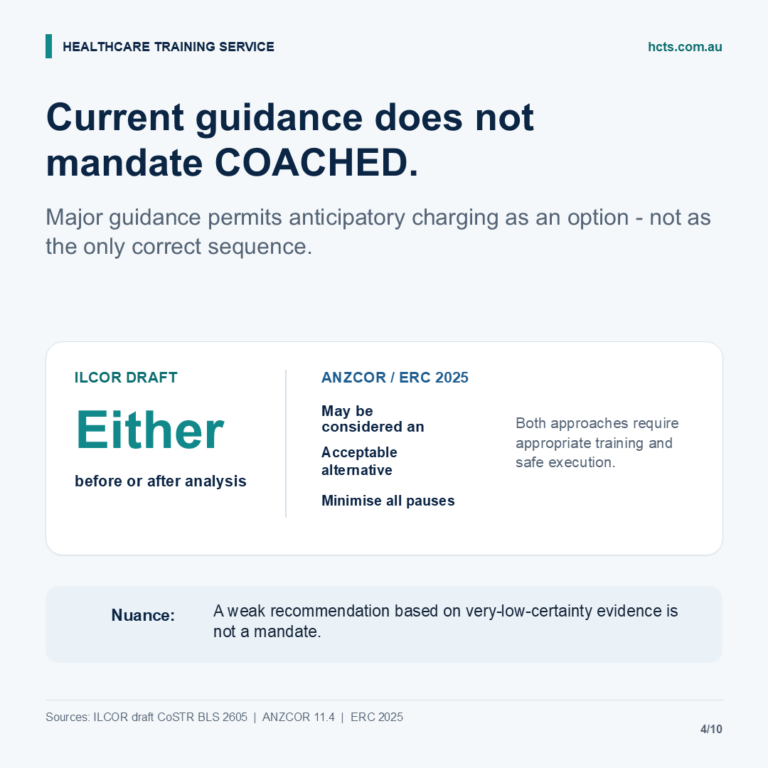
ANZCOR states that anticipatory charging may be considered as part of a defibrillation strategy and that training should emphasise minimising all pauses. ANZCOR also acknowledges that anticipatory charging can reduce overall chest-compression pause duration while increasing pre-shock, post-shock and peri-shock pauses, with the clinical relevance still undetermined.
ERC 2025 retains the conventional sequence of continuing chest compressions during charging, delivering the shock with an interruption of less than five seconds, and immediately resuming compressions. It also describes anticipatory charging as an acceptable alternative when it can be performed without prolonging the peri-shock pause.
The current ILCOR draft Consensus on Science with Treatment Recommendations suggests charging a manual defibrillator during chest compressions either before or after rhythm analysis. This is a weak recommendation based on very-low-certainty evidence, accompanied by a good-practice statement requiring appropriate training, safe defibrillation and minimal pauses.
“May be considered”, “acceptable alternative” and “either before or after” do not mean mandatory or proven superior.
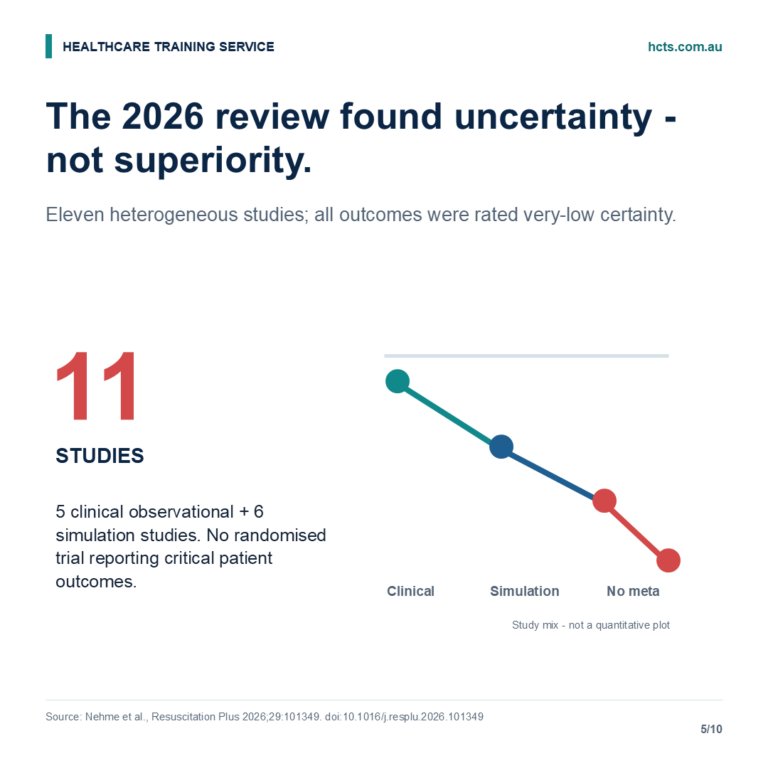
TThe 2026 ILCOR-commissioned systematic review included 11 heterogeneous studies: five retrospective clinical observational studies and six simulation studies. No randomised clinical trial reported critical patient outcomes, and the certainty of evidence was rated very low for every outcome. The variation in methods and bundled interventions prevented meta-analysis.
Across clinical and simulation studies, anticipatory charging generally reduced interruptions when compared with standard charging after rhythm analysis. That is a relevant process benefit in some systems. However, comparisons with the conventional ERC/AHA analyse-first method were inconsistent, and the effects on survival and neurological outcome remain uncertain.
The correct conclusion is therefore measured: anticipatory charging is feasible and may improve selected pause metrics, but current evidence does not establish that it is clinically superior to a well-executed conventional sequence.
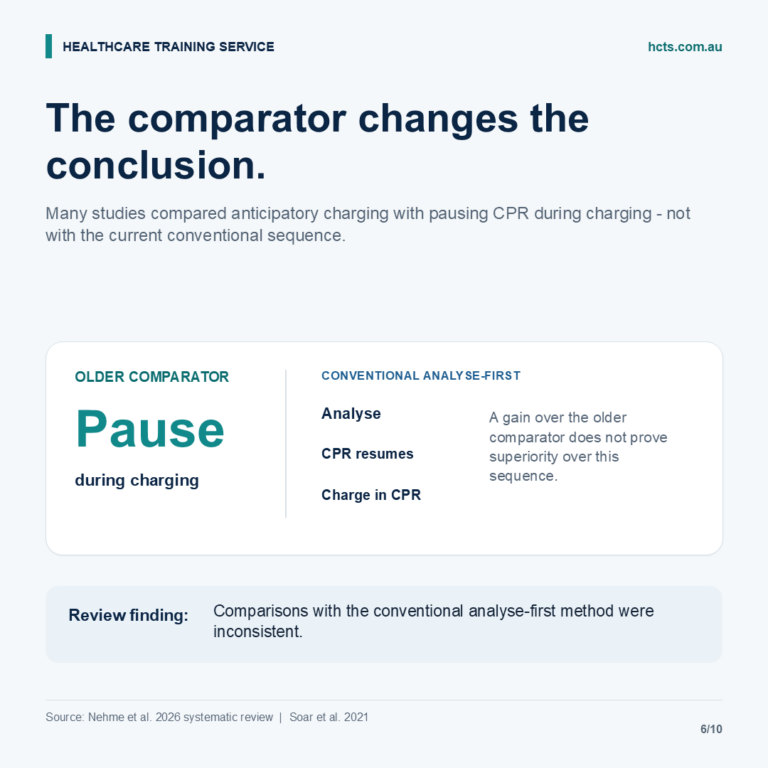
The term standard charging has not always described the same workflow in defibrillation studies. This can create a misleading comparison.
Compressions are paused to assess the rhythm and remain paused while the defibrillator charges. HCTS does not teach this method.
Compressions are paused briefly for rhythm analysis, then resumed while the defibrillator charges. This is the method HCTS teaches and ERC 2025 continues to support.
Anticipatory charging has not automatically been shown to perform better than the current conventional analyse-first sequence. The 2026 review found the direct comparisons with the conventional sequence inconsistent.
The systematic review previously conducted refers to the ERC/AHA 2010 charging method because that is the historical guideline label used in the comparison literature. The method itself is now outdated. ERC 2025 supports the operational principle of continuing compressions during defibrillator charging and limiting the interruption required for shock delivery.
Clinical implication Ask what the comparator actually required. A label such as “standard” can conceal a clinically important difference in no-flow time.
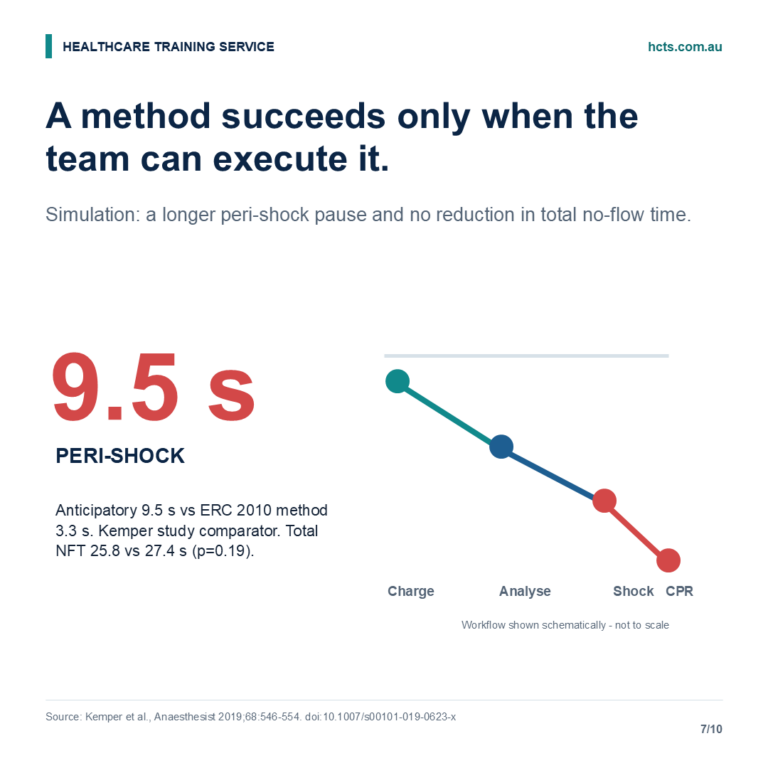
A simulation study by Kemper and colleagues compared an anticipatory charging strategy with the then-current ERC 2010 method. Anticipatory charging produced a longer peri-shock pause: 9.5 seconds compared with 3.3 seconds. Total no-flow time was not significantly different: 25.8 seconds versus 27.4 seconds.
This does not prove that anticipatory charging is harmful. It demonstrates something more useful for education: a theoretically efficient sequence can perform poorly if the team is unfamiliar with it, communication is weak or the workflow is inconsistently applied.
The 2026 systematic review reached a similar practical conclusion. The effect of anticipatory charging depends heavily on training, protocol design, team familiarity and implementation quality.
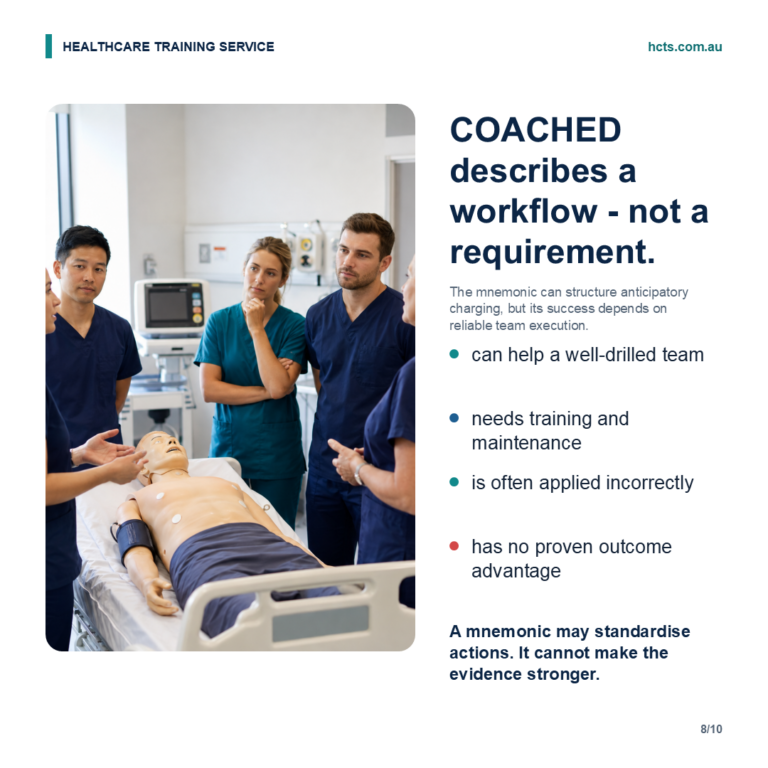
A mnemonic can standardise actions. It cannot make the underlying evidence stronger.
COACHED can provide a useful structure for teams that have deliberately adopted anticipatory charging. In a well-trained system, that structure may improve coordination and reduce selected pauses.
The limitation is not the acronym itself. The problem arises when the mnemonic is treated as proof that one defibrillation sequence is universally correct.
For education and governance, the distinction should remain clear:
HCTS therefore does not teach COACHED as the only acceptable contemporary method of manual defibrillation.
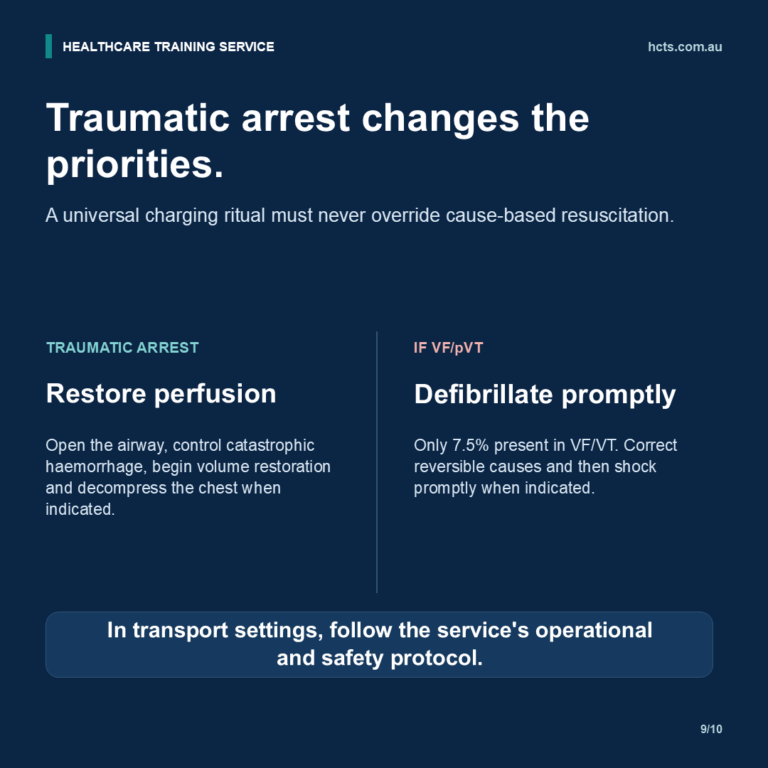
Traumatic cardiac arrest is not simply medical cardiac arrest with a different cause. The immediate priority is rapid correction of reversible causes such as airway obstruction, catastrophic haemorrhage, tension pneumothorax and hypovolaemia.
Only a minority of traumatic cardiac arrest patients present in VF or pulseless VT. When a shockable rhythm is present, defibrillation should be delivered promptly, but it should not displace the simultaneous correction of reversible causes.
For this reason, a universal charging ritual should never override cause-based resuscitation. In transport and retrieval settings, defibrillation practice must also align with the service’s operational and safety protocols.
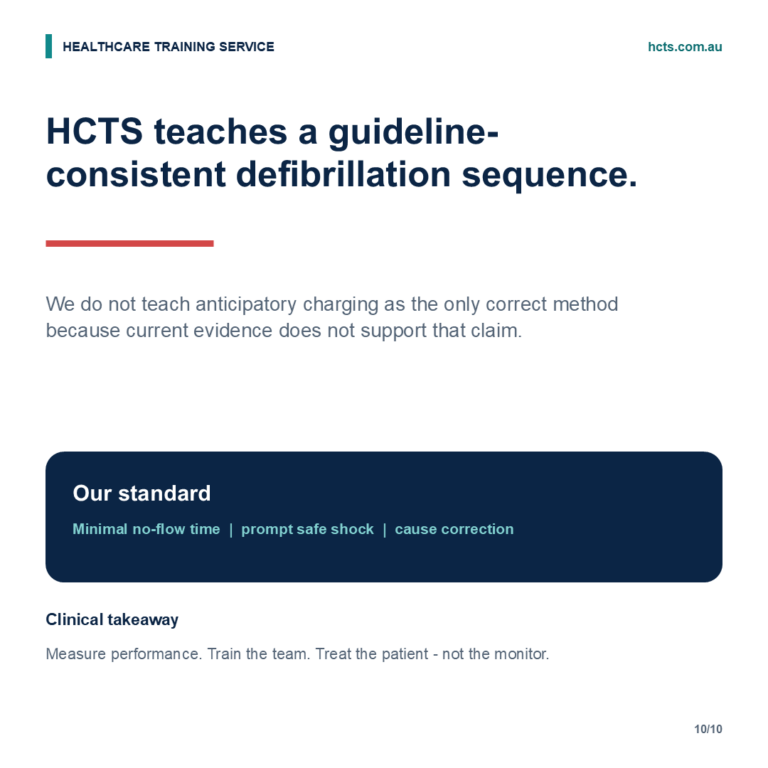
HCTS teaches a guideline-consistent defibrillation sequence designed to achieve:
Anticipatory charging can also achieve these goals when implemented well. Current evidence does not justify teaching it as the only correct method.
The standard is performance: measure the pauses, train the team and treat the patient – not the monitor.
HealthCare Training Service provides Advanced Life Support and Paediatric Advanced Life Support education designed to build practical competence, clinical reasoning and confidence under pressure.
Educational note: This article is intended for healthcare education and should be read alongside current resuscitation guidelines, organisational policies, equipment instructions and local clinical governance.
1. Soar J, Böttiger BW, Carli P, et al. European Resuscitation Council Guidelines 2025: Adult Advanced Life Support. Resuscitation. 2025;215(Suppl 1):110769. doi:10.1016/j.resuscitation.2025.110769. View source
2. Australian and New Zealand Committee on Resuscitation. Guideline 11.4 – Electrical Therapy for Adult Advanced Life Support. Accessed 30 September 2026. View source
3. Nehme Z, Pocock H, Norii T, et al. Anticipatory charging of the defibrillator: a systematic review. Resusc Plus. 2026;29:101349. doi:10.1016/j.resplu.2026.101349. View source
4. International Liaison Committee on Resuscitation. BLS 2605 Anticipatory charging of the defibrillator: Task Force systematic review and draft Consensus on Science with Treatment Recommendations. Draft for public comment; accessed 30 September 2026. View source
5. Otto Q, Musiol S, Deakin CD, Morley P, Soar J. Anticipatory manual defibrillator charging during advanced life support: a scoping review. Resusc Plus. 2020;1-2:100004. doi:10.1016/j.resplu.2020.100004. View source
6. Coggins A, Nottingham C, Chin M, et al. A prospective evaluation of the C.O.A.C.H.E.D. cognitive aid for emergency defibrillation. Australas Emerg Care. 2018;21(3):81-86. doi:10.1016/j.auec.2018.08.002. View source
7. Kemper M, Zech A, Lazarovici M, et al. Defibrillator charging before rhythm analysis causes peri-shock pauses exceeding guideline recommended maximum 5 s: a randomized simulation trial. Anaesthesist. 2019;68(8):546-554. doi:10.1007/s00101-019-0623-x. View source
8. Cheskes S, Schmicker RH, Christenson J, et al. Perishock pause: an independent predictor of survival from out-of-hospital shockable cardiac arrest. Circulation. 2011;124(1):58-66. doi:10.1161/CIRCULATIONAHA.110.010736. View source
9. Australian and New Zealand Committee on Resuscitation. Guideline 11.10.1 – Management of Cardiac Arrest due to Trauma. Accessed 30 September 2026. View source