“Complexity is the enemy of execution” is a phrase credited to Tony Robbins. In business, it describes the friction that can develop between a strategy and the ability to carry it out. In resuscitation, the principle has a more immediate consequence: when a structure consumes attention without improving action, it can delay care.
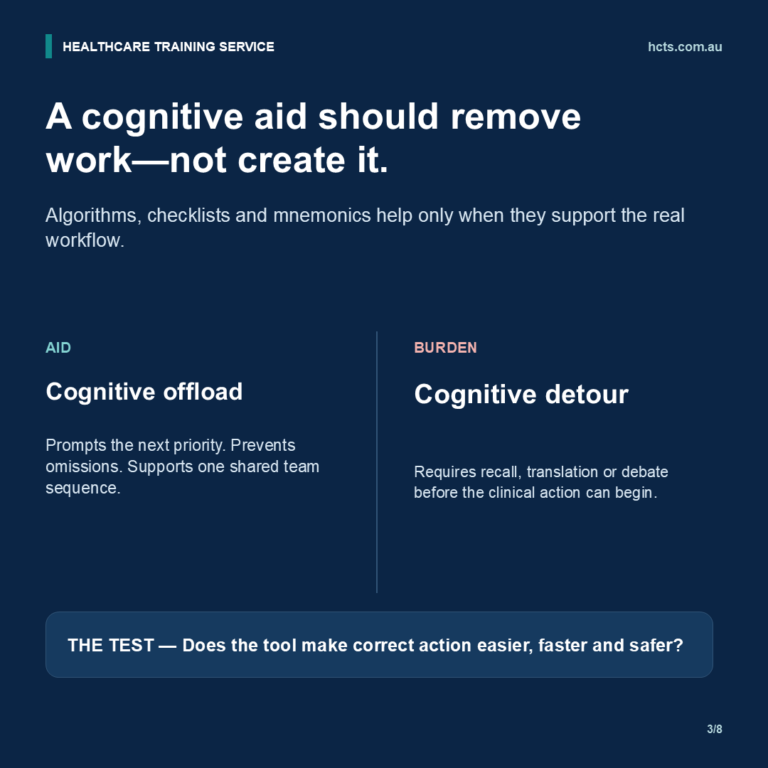
This is not an argument against algorithms, checklists or mnemonics. Each can support performance. The question is functional: does the tool make the correct clinical action easier, faster and safer?
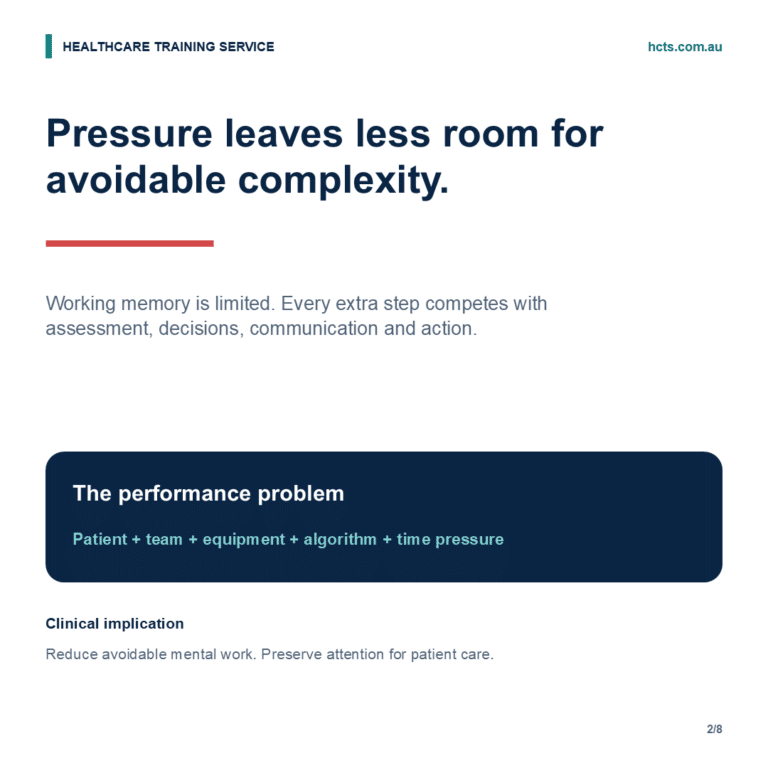
During resuscitation, clinicians must assess the patient, interpret changing information, communicate with the team, operate equipment, follow evidence-based priorities and act within seconds. Working memory is limited, and every unnecessary step competes with the attention required for patient care.
Experience helps clinicians organise familiar information into meaningful patterns, but expertise does not make attention unlimited. Roles, workflow, equipment, cognitive aids, experience and the clinical environment can all influence workload and stress during resuscitation.
Clinical implication: Reduce avoidable mental work. Preserve attention for assessment, decisions, communication and action.
Cognitive aids can prompt the next priority, prevent omissions and support a shared team sequence. Evidence from simulated in-hospital cardiac arrest scenarios suggests that cognitive aids may improve overall performance, although study methods and results vary considerably.
The limitations matter. A 2024 International Liaison Committee on Resuscitation systematic review rated the available evidence as very low certainty and identified no real-life cardiac arrest studies reporting patient outcomes. Cognitive aids should therefore be judged by how well they function in the intended environment, not by the assumption that any aid is automatically beneficial.
A useful aid provides cognitive offload:
An unsuitable or poorly learned aid can create a cognitive detour:
The practical test: Does the tool shorten the path from recognition to safe action, or does it become another task?
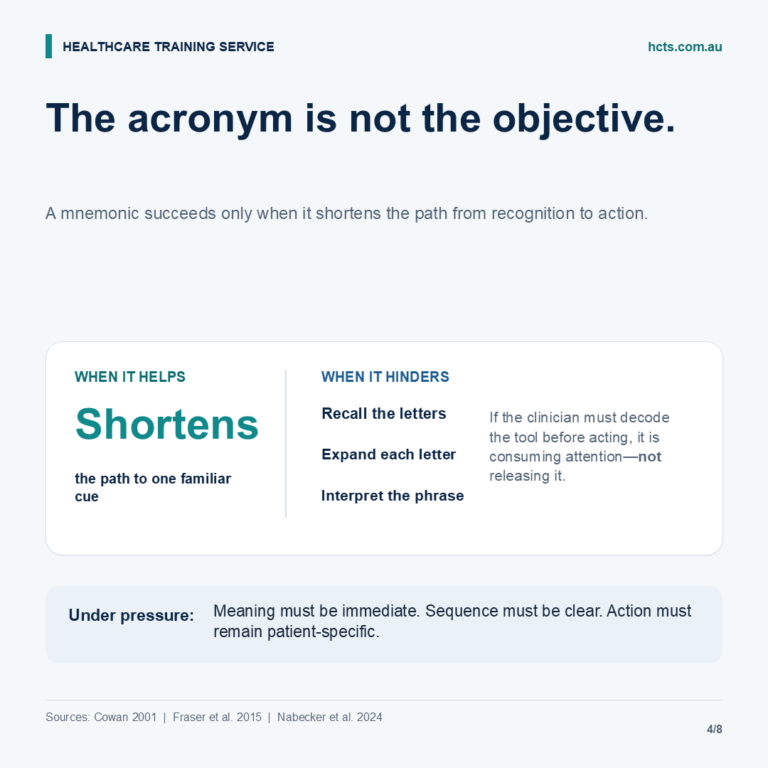
A mnemonic succeeds when it compresses information into one familiar cue and makes the next priority immediately clear. It is less useful when it merely hides complexity behind a pronounceable word.
Rehearsal can make a complex aid fluent, particularly for experienced teams working within a consistent system. Until that fluency is achieved, however, recalling and decoding the mnemonic may add extraneous mental work at precisely the time attention is most constrained.
The objective in resuscitation is never to recite an acronym perfectly. The objective is to recognise the clinical priority, deliver the correct intervention safely and evaluate whether it worked.
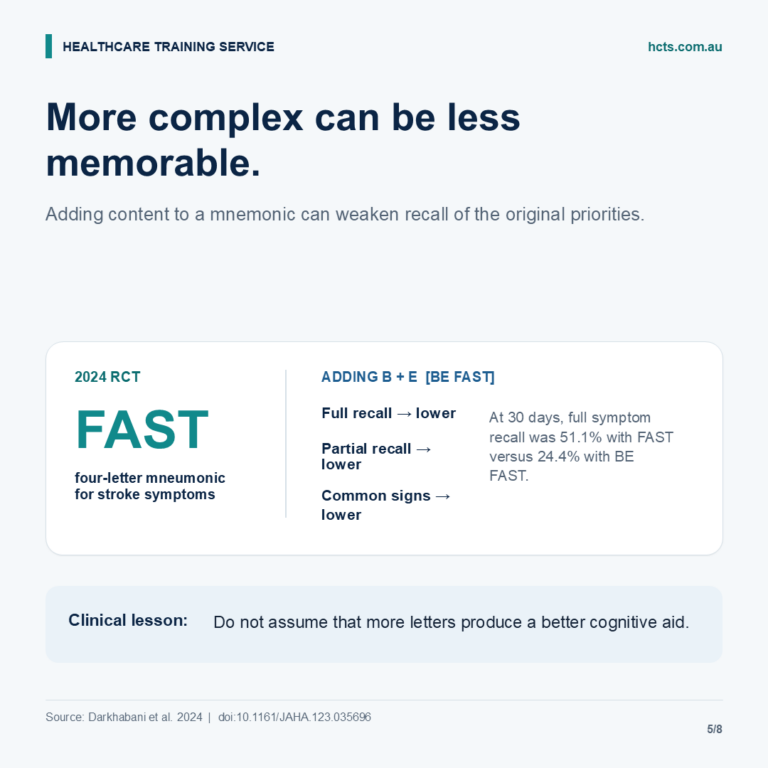
An instructive example comes from stroke education. In a 2024 randomised pilot trial, the four-letter FAST mnemonic produced better full and partial symptom recall than the expanded BE FAST mnemonic. At 30 days, full symptom recall was 51.1% with FAST compared with 24.4% with BE FAST.
This was a public stroke-awareness study, not a study of clinician performance during resuscitation. It should not be overgeneralised. It does, however, illustrate an important design principle: adding more information may appear more complete while making the original priorities harder to remember. Simply stated, adding more letters to an acronym increases complexity with the risk of decreasing performance.
Clinical lesson: Do not assume that more letters produce a better cognitive aid.
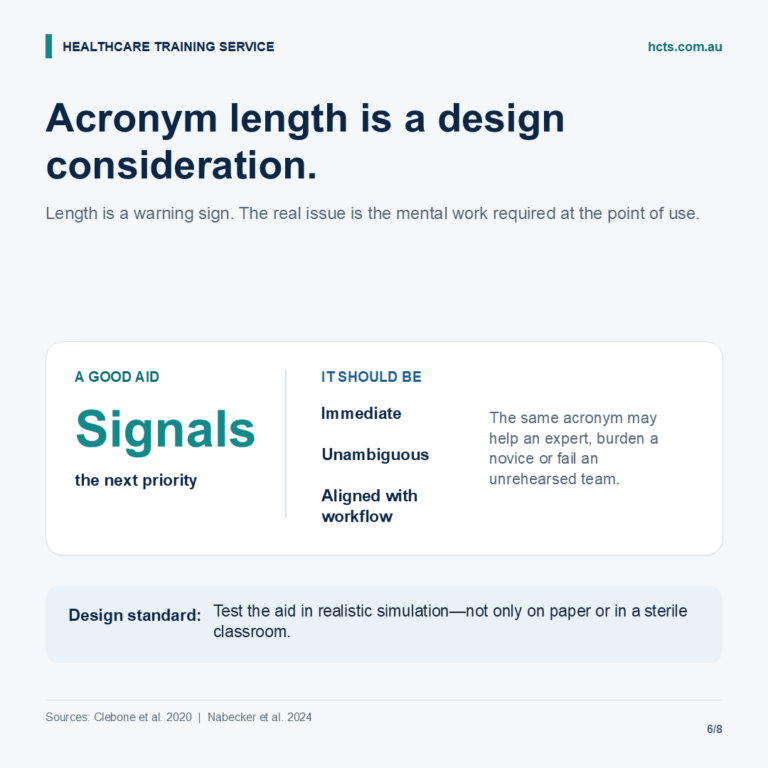
There is no validated clinical evidence for a universal cut-off at seven letters, four letters or any other number. Length is a warning sign, not a verdict. The real issue is the amount of mental work required at the point of use.
A cognitive aid should be examined for:
The same mnemonic may help an expert, burden a novice or fail an unrehearsed team. Good design is immediate, unambiguous and integrated with the work clinicians must actually perform.
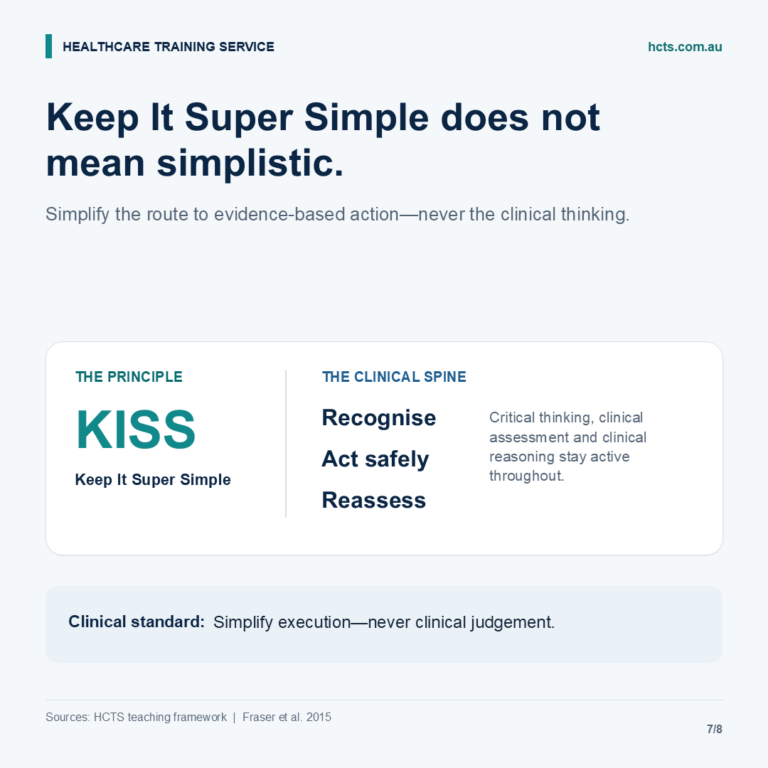
The KISS principle has an important place in high-pressure clinical care, but simplicity must never be confused with the removal of clinical judgement. It means removing avoidable friction from the route to evidence-based action.
A simple clinical spine is:
Critical thinking, clinical assessment and clinical reasoning remain active before, during and after every step. Simplicity should strengthen execution; it should never replace thought.
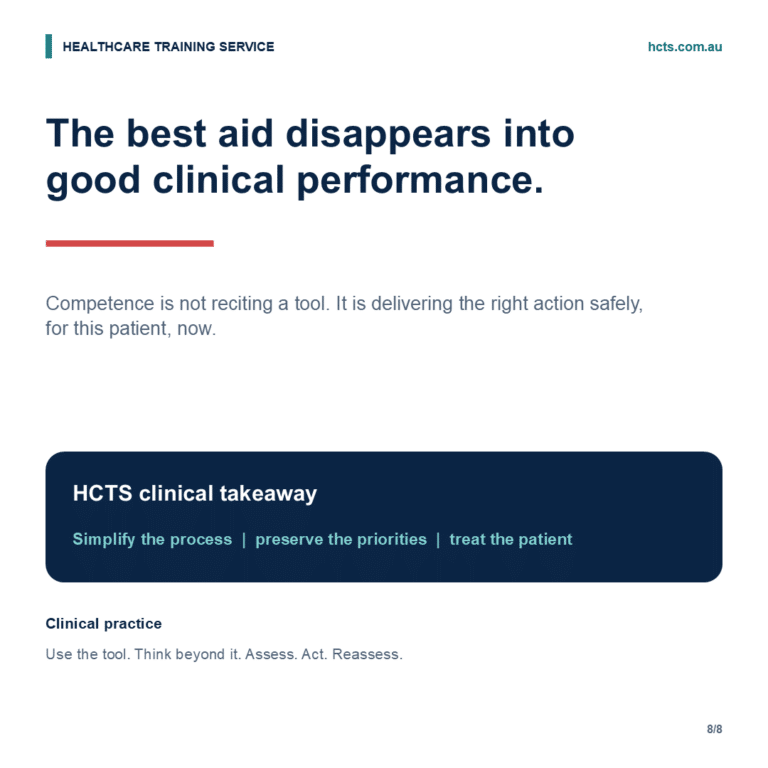
Advanced Life Support competence is not demonstrated by reciting a tool. It is demonstrated by recognising the problem, communicating clearly, delivering the right action safely and reassessing the patient while the cognitive aid quietly supports the work.
HCTS clinical takeaway
Simplify the process. Preserve the priorities. Treat the patient.
Use the tool. Think beyond it. Assess. Act. Reassess.
HealthCare Training Service provides Advanced Life Support and Paediatric Advanced Life Support education designed to build practical competence, clinical reasoning and confidence under pressure.
Educational note: This article is intended for healthcare education and should be read alongside current resuscitation guidelines, organisational policies and local clinical governance.
1. Robbins T. Inside the mindset of CEOs who scale. Tony Robbins website. Used only for attribution of the phrase ‘Complexity is the enemy of execution.’ View source
2. Cowan N. The magical number 4 in short-term memory: a reconsideration of mental storage capacity. Behav Brain Sci. 2001;24(1):87-114. doi:10.1017/S0140525X01003922. View source
3. Fraser KL, Ayres P, Sweller J. Cognitive Load Theory for the Design of Medical Simulations. Simul Healthc. 2015;10(5):295-307. doi:10.1097/SIH.0000000000000097. View source
4. Liu CH, Yang CW, Lockey A, Greif R, Cheng A. Factors influencing workload and stress during resuscitation: a scoping review. Resusc Plus. 2024;18:100630. doi:10.1016/j.resplu.2024.100630. View source
5. Corazza F, Fiorese E, Arpone M, et al. The impact of cognitive aids on resuscitation performance in in-hospital cardiac arrest scenarios: a systematic review and meta-analysis. Intern Emerg Med. 2022;17(7):2143-2158. doi:10.1007/s11739-022-03041-6. View source
6. Nabecker S, Nation K, Gilfoyle E, et al. Cognitive aids used in simulated resuscitation: a systematic review. Resusc Plus. 2024;19:100675. doi:10.1016/j.resplu.2024.100675. View source
7. Darkhabani MZ, Homa-Bonell JK, Thoreson L, et al. BE FAST Versus FAST: A Randomized Pilot Trial Comparing Retention of Stroke Symptoms Between 2 Mnemonics. J Am Heart Assoc. 2024;13(19):e035696. doi:10.1161/JAHA.123.035696. View source
8. Clebone A, Burian BK, Tung A. The effect of cognitive aid design on the perceived usability of critical event cognitive aids. Acta Anaesthesiol Scand. 2020;64(3):378-384. doi:10.1111/aas.13503. View source