A certificate confirms that a clinician met a standard on the day of assessment. It cannot guarantee that rarely used knowledge, practical skills, team behaviours and clinical reasoning will remain immediately available for several years without reinforcement.
Advanced Life Support is built around infrequent, high-risk events. Most clinicians do not perform every component of a resuscitation often enough for the required knowledge and actions to remain automatic. That is fortunate for patients, but it creates an unavoidable education problem: without deliberate reinforcement, performance can decline.
This matters because knowing something in a classroom is not the same as retrieving and applying it during a time-critical emergency. Clinicians must recognise deterioration, coordinate a team, interpret a rhythm, use equipment, deliver treatment safely and reassess while under pressure. A delay, omission or loss of fluency can affect the entire response.
At HealthCare Training Service, annual assessed recertification is therefore a practical minimum. It is not based on the idea that competence remains fixed for twelve months and then suddenly expires. It is a defined opportunity to revisit current evidence, practise essential actions and demonstrate that the required standard can still be met. Frequent repetition builds muscle memory and proficiency.
A certificate is evidence that a learner completed the required education and met the assessment standard on a particular date. It is valuable, but it is not a guarantee of unchanged performance for every year that follows.
Administrative recognition periods and clinical competence answer different questions. A multi-year certificate may satisfy an employer, college or program requirement. That interval does not establish that an individual clinician’s knowledge, technical skills, team behaviours or clinical reasoning remain immediately retrievable throughout the same period.
Clinical distinction Certificate validity is an administrative decision. Current competence is a performance question.
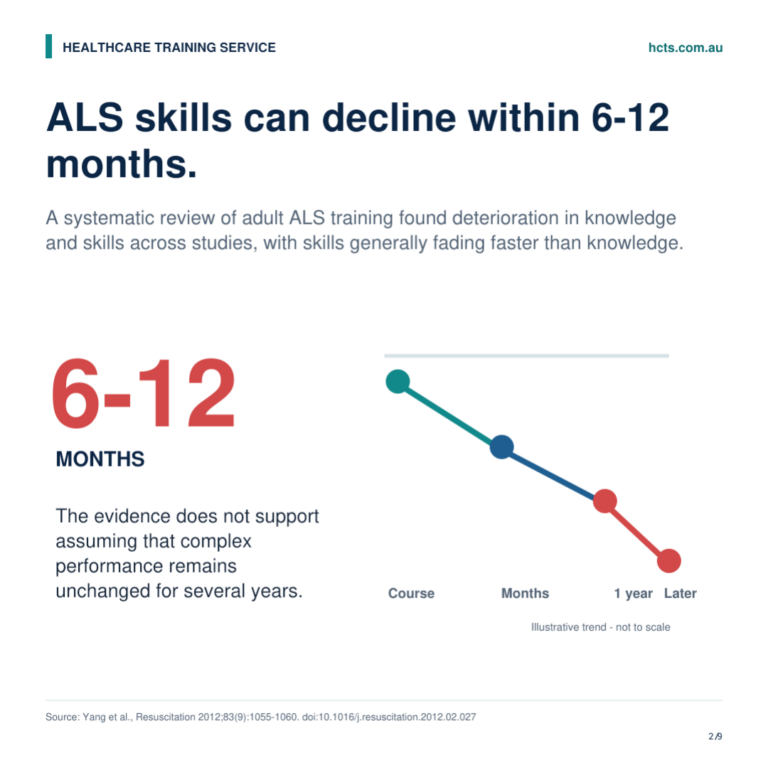
The current Australian and New Zealand Committee on Resuscitation guideline states that resuscitation knowledge and skills may deteriorate within six months without ongoing practice. It also notes that CPR skills can decline within weeks to months after a traditional single-encounter course – well before customary retraining intervals.
This does not mean that every clinician deteriorates at the same rate. Retention is influenced by prior experience, clinical exposure, the skill being assessed, the quality of initial learning, and whether practice continues. The important point is that a long interval on a certificate cannot be treated as evidence that competence has remained unchanged.
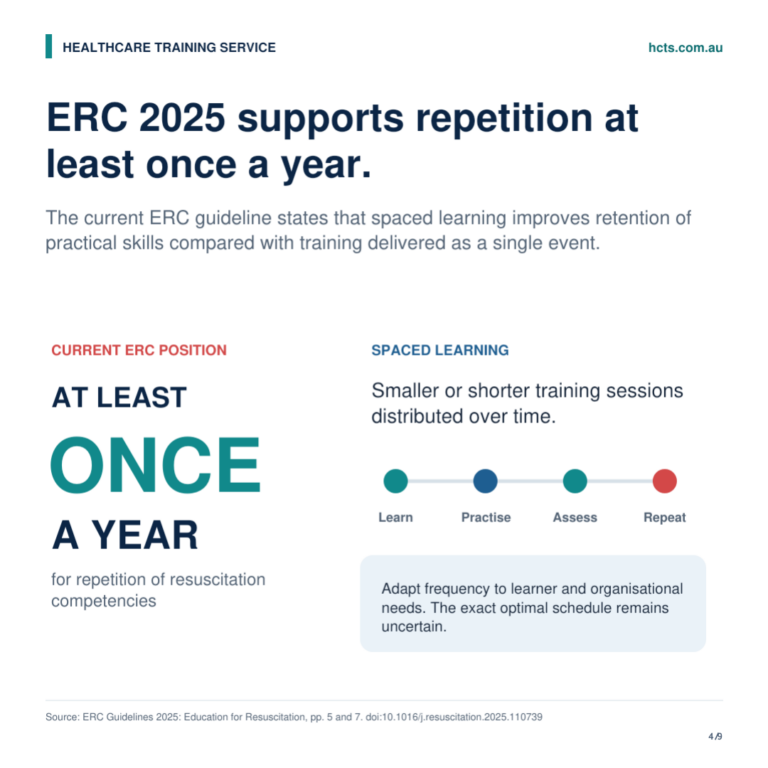
The European Resuscitation Council’s 2025 Education for Resuscitation guideline recommends spaced learning to improve the acquisition and retention of competencies. It explains that smaller or shorter sessions distributed over time improve retention of practical skills compared with learning concentrated into a single event and not revisiting knowledge and skills for years.
The ERC also states that training frequency should be adapted to the needs of learners and organisations. Although the precise optimal schedule remains uncertain, repetition of resuscitation competencies at least once a year is considered reasonable.
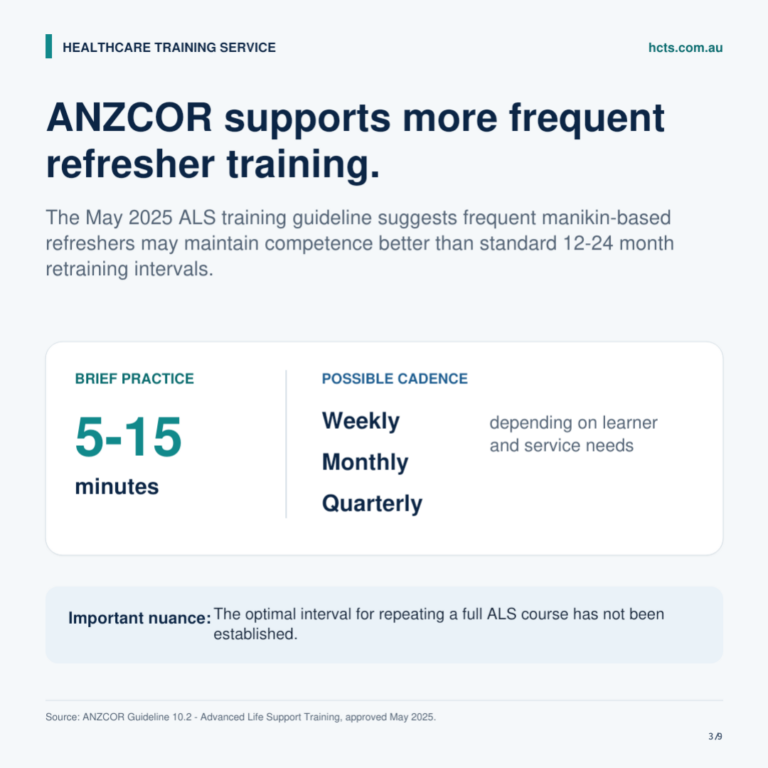
ANZCOR distinguishes between repeating an entire ALS course and undertaking refresher activity. The optimal interval for recompleting a full ALS course has not been established. However, ANZCOR states that repeated refresher training is needed for people who do not perform resuscitation regularly and that 12- to 24-month retraining cycles are not adequate to maintain high-quality resuscitation skills.
Its practical response is low-dose, high-frequency training: brief, focused manikin sessions repeated weekly, monthly or quarterly according to learner need and operational feasibility. ANZCOR also supports a minimum passing standard where practical, using observable performance behaviours rather than attendance alone, that is highlighting competence over attendance.
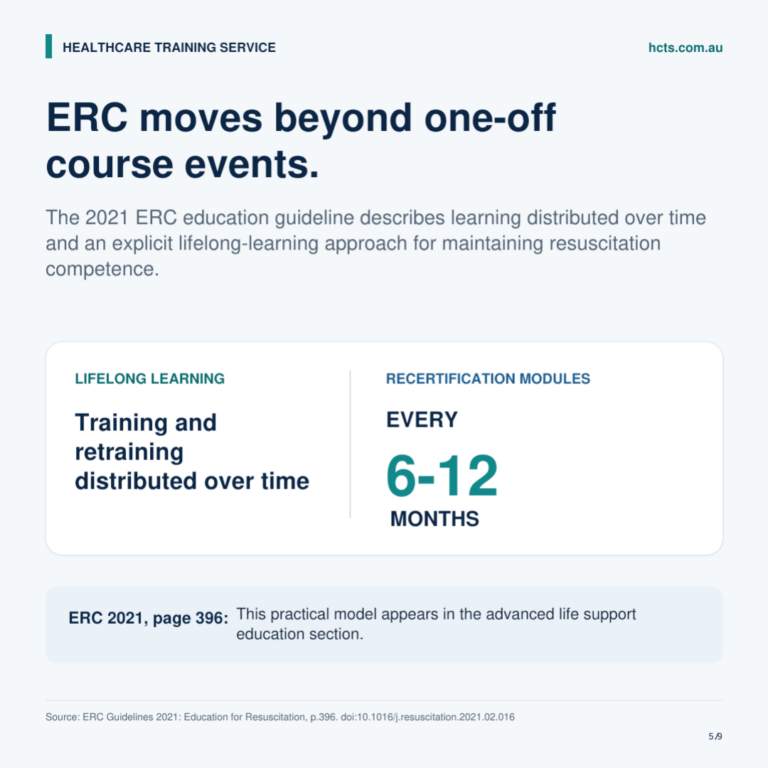
The ERC’s 2021 education guideline described a lifelong-learning approach in which learning is distributed over time rather than confined to isolated course events. Its proposed model included recertification modules every six to twelve months. The 2025 guideline continues that direction by explicitly supporting spaced learning and at-least-annual repetition of competencies.
What the guidance supports Frequent practice, spaced learning and at-least-annual repetition are supported. A universal interval for repeating a complete ALS course has not been established.
A well-designed annual recertification course provides a structured point at which knowledge, practical skills, team performance and clinical reasoning can be reviewed together. It is a defensible minimum interval for formal reassessment. It should not be mistaken for the entire maintenance strategy.
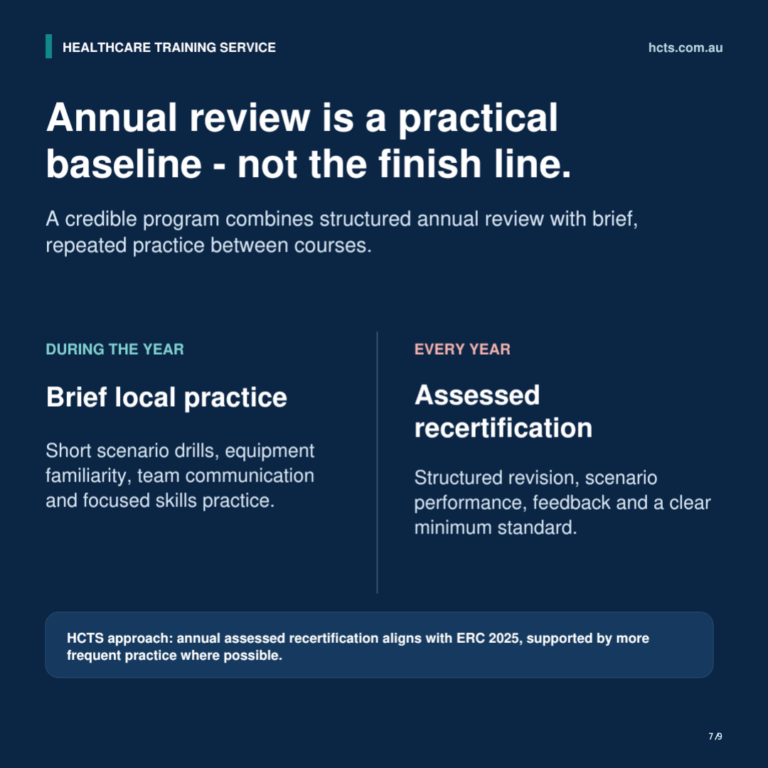
If skills may deteriorate within months, the logical response is not simply to shorten the date printed on a certificate. It is to combine formal assessed recertification with brief, repeated practice during the year. The two elements serve different purposes: recertification verifies performance against a standard; shorter practice keeps essential actions familiar and retrievable.
Recertification is meaningful only when the certificate represents demonstrated performance. A clinician should not receive certification merely for being present. The learning environment should be supportive, but the performance standard must remain clear.
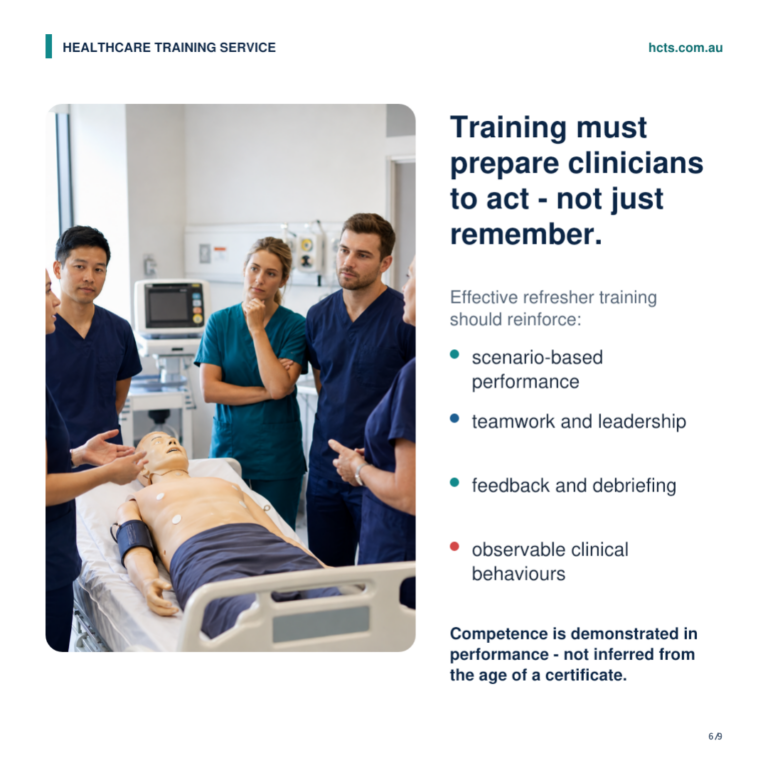
Assessment should examine the behaviours that matter in a real response, including recognition, prioritisation, defibrillation safety, airway and ventilation skills, treatment of reversible causes, leadership, communication and reassessment. Scenariobased performance allows these elements to be integrated rather than recalled as disconnected facts.
Feedback and debriefing are equally important. They make the reasoning behind decisions visible, identify gaps that may not be apparent to the learner and create a plan for improvement. Where the standard is not yet met, further practice and reassessment protect the meaning of the certificate.
HCTS standard A certificate should mean that the clinician demonstrated the required standard – not simply that they spent the day in the room.
Even experienced clinicians may have limited exposure to cardiac arrest, and repeated exposure does not guarantee practice across every role or skill. One clinician may lead regularly but rarely defibrillate; another may perform compressions but seldom manage the airway, prepare resuscitation drugs or coordinate reversible-cause treatment.
Experience is valuable, but it is variable. Planned practice ensures that low-frequency, high-risk actions are rehearsed before they are required for a real patient.
Maintaining resuscitation competence does not require every refresher to become another full course. ANZCOR describes brief sessions of approximately five to fifteen minutes, adjusted to the needs and resources of the service. The activity should target observable performance and use equipment, protocols and team roles that resemble the clinical environment.
Useful workplace activities may include:
These activities do not replace comprehensive learning or formal assessment. Their value lies in reinforcing critical actions before memory, coordination and equipment familiarity are tested in an actual emergency.
Annual recertification is a baseline, not a ceiling. More frequent practice may be required when exposure is low, staff are new to a role, equipment or protocols change, local performance data identify a gap, or the clinical consequences of delay are especially high.
A service that manages cardiac arrest frequently may need practice targeted to team coordination, unusual events or weak points identified through debriefing. A service with rare exposure may need more frequent rehearsal of the core sequence and equipment. The schedule should be intentional, risk-based and achievable.
At the 2026 European Resuscitation Council Congress in Milan, Italy, the education sessions repeatedly returned to the same themes: skills decay, learning distributed over time, practice to mastery, realistic context and feedback that improves future performance.
For HCTS, the Congress did not create a new position. It reinforced our position already supported by the published guidance: resuscitation education should be treated as continuing capability development, not as an isolated course followed by several years of assumed competence.
HCTS certificates are valid for twelve months, and annual assessed recertification is required. This is an HCTS provider policy grounded in the known risk of skill decay, the rare and high-stakes nature of resuscitation, and current ERC and ANZCOR education guidance. HCTS position is not presented as a universal rule mandated by every provider, but it is supported by current evidence and science.
Our approach combines evidence-based pre-course preparation with practical, scenario-based learning and assessment. Certification is firm but fair: candidates are supported to learn, practise and improve, while the standard required for certification remains meaningful.
We also support brief, repeated practice between formal courses wherever organisations can provide it. Annual recertification creates a credible checkpoint; spaced practice strengthens the capability that must exist on every day between checkpoints.
When an organisation chooses a retraining interval, it should ask what evidence supports the assumption that performance will remain adequate for that long. Convenience, cost and workforce availability are genuine implementation considerations, but they do not change the way human knowledge and skills are retained.
A defensible education system should distinguish administrative compliance from demonstrated competence, provide practice proportional to clinical risk and make the expected performance standard clear.
Competence is demonstrated in performance – not inferred from the age of a certificate. Annual assessed recertification is a practical minimum. Brief, repeated practice helps keep critical actions retrievable. Patient safety deserves more than a certificate date.
HealthCare Training Service provides Adult Advanced Life Support and Paediatric Advanced Life Support education designed to build practical competence, clinical reasoning and confidence under pressure.
Website buttons:
• View Adult Advanced Life Support Courses – link to the current HCTS ALS course page.
• View Paediatric Advanced Life Support Courses – link to the current HCTS PALS course page.
Educational note: This article is intended for healthcare education and should be read alongside current resuscitation guidelines, organisational policies and local clinical governance.
1. Nabecker S, de Raad T, Abelairas-Gomez C, et al. European Resuscitation Council Guidelines 2025: Education for Resuscitation. Resuscitation. 2025;215(Suppl 1):110739. doi:10.1016/j.resuscitation.2025.110739. View source
2. Greif R, Lockey A, Breckwoldt J, et al. European Resuscitation Council Guidelines 2021: Education for resuscitation. Resuscitation. 2021;161:388-407. See p.396 for the lifelong-learning model and recertification modules every 6-12 months. doi:10.1016/j.resuscitation.2021.02.016.View source
3. Australian and New Zealand Committee on Resuscitation. Guideline 10.2 – Advanced Life Support (ALS) Training. Approved May 2025; current online version. Accessed 1 October 2026. View source
4. Yeung J, Djarv T, Hsieh MJ, et al. Spaced learning versus massed learning in resuscitation – a systematic review. Resuscitation. 2020;156:61-71. doi:10.1016/j.resuscitation.2020.08.132. View source
5. Yang CW, Yen ZS, McGowan JE, et al. A systematic review of retention of adult advanced life support knowledge and skills in healthcare providers. Resuscitation. 2012;83(9):1055-1060. doi:10.1016/j.resuscitation.2012.02.027. Foundational review cited on carousel slide 2; the article position is led by the current ERC and ANZCOR guidance above. View source
Current guidance does not establish a single optimal interval for every clinician to repeat a complete ALS course. ERC 2025 states that repetition of resuscitation competencies at least annually is reasonable, while ANZCOR 2025 supports frequent refresher activity and states that traditional 12- to 24-month cycles are not adequate to maintain high-quality resuscitation skills.
Annual assessed recertification is the HCTS evidence-informed provider policy. The article deliberately distinguishes that policy from a universal external mandate and presents brief, repeated practice between formal courses as an important part of competence maintenance.
The paragraph about the 2026 ERC Congress reports HCTS’s direct professional observation of the education sessions in Milan, Italy. It is used as contextual reinforcement only; the clinical and educational claims in the article are supported by the published sources above.