A patient’s history can suggest the cause of deterioration or cardiac arrest, but it cannot determine it. Safe clinical judgement requires clinicians to think critically, assess the patient, connect findings to physiology and reassess the response.
When a patient deteriorates, clinicians rarely receive a complete and reliable picture at the outset. They receive a history, a handover, observations, monitor data, examination findings and the patient’s response to what has already been tried. Every element contributes evidence. No single element should automatically become the diagnosis.
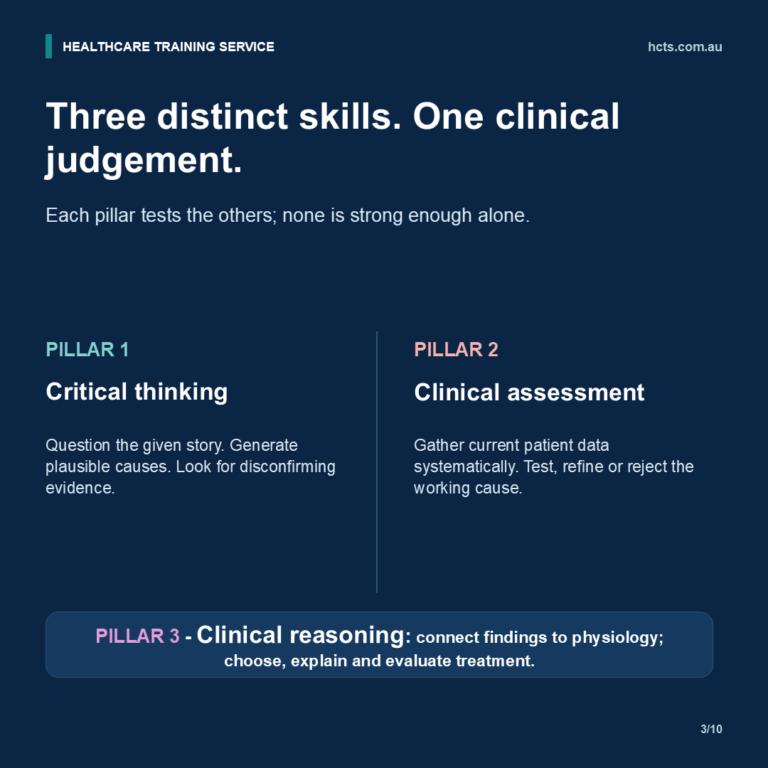
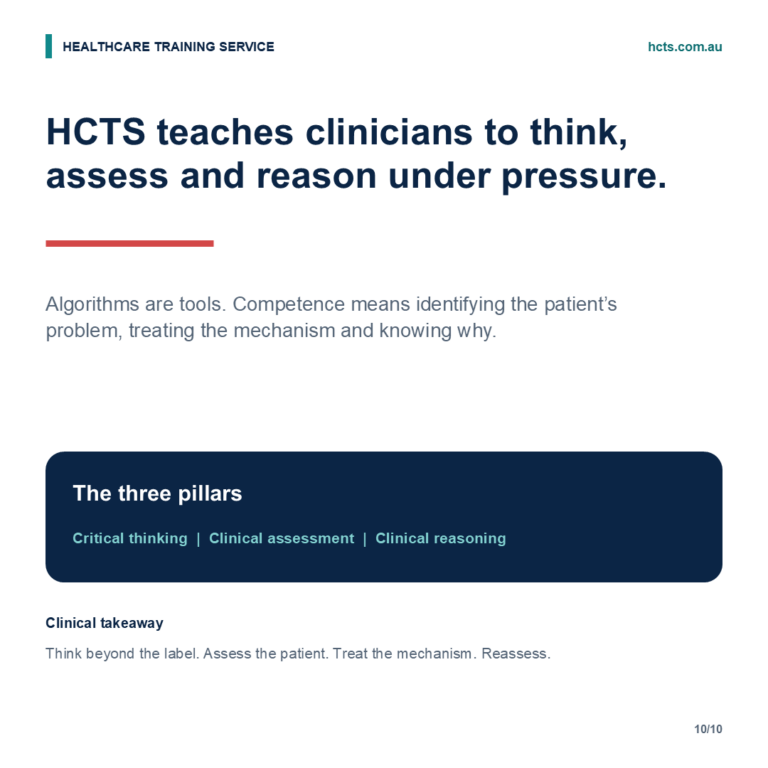
At HealthCare Training Service, we teach critical thinking, clinical assessment and clinical reasoning as the three pillars of a good clinician. This is an HCTS teaching framework developed through clinical practice and education. It is not presented as an established named model from the literature.
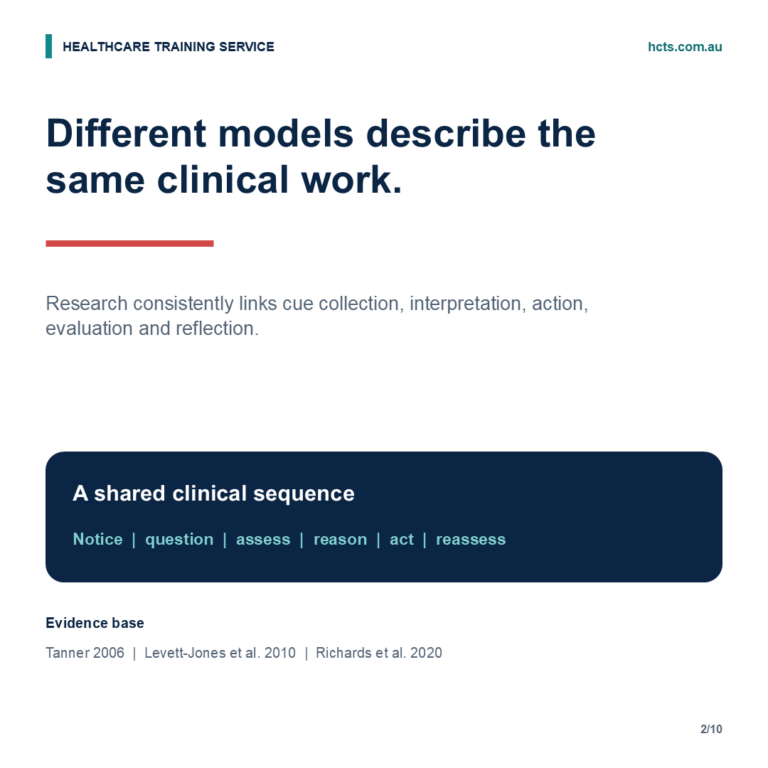
Its foundations are nevertheless strongly supported. Tanner’s1 clinical judgement model describes noticing, interpreting, responding and reflecting. Levett-Jones2 and colleagues describe collecting cues, processing information, understanding the patient’s problem, acting, evaluating outcomes and reflecting. Richards3 and colleagues describe clinical reasoning as identifying and prioritising relevant clinical data to develop and test a hypothesis, supported by critical thinking.
The terminology differs, but the clinical work is recognisable: notice what is happening, question the first explanation, assess the patient, connect the findings to physiology, act and evaluate the response.
The pillars are described separately so they can be taught and examined. In practice, they operate together and repeatedly. A new finding changes the hypothesis; treatment creates new information; reassessment may redirect the entire plan.
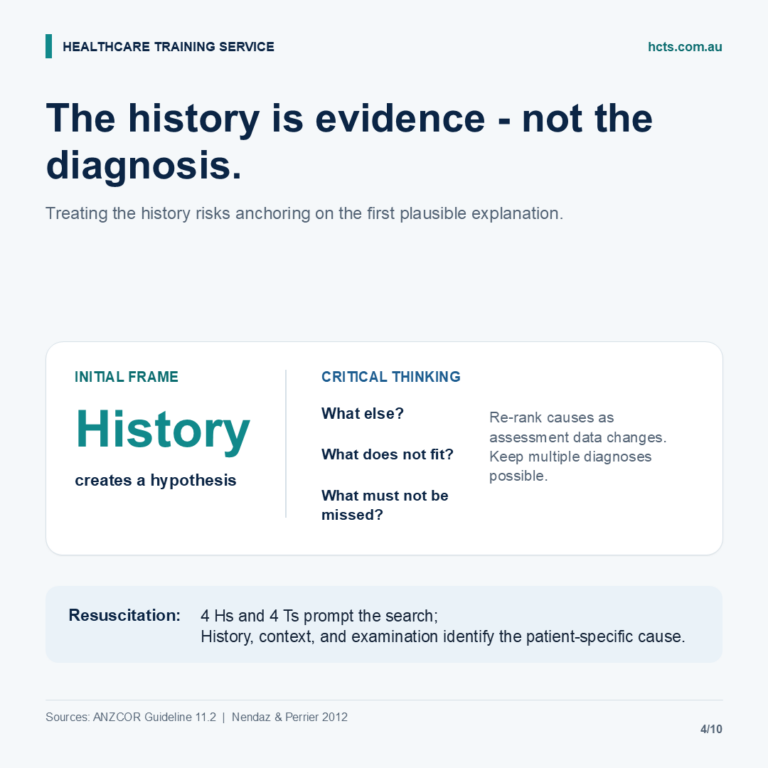
A history is clinically important, but it is evidence rather than a diagnosis. The presenting label can create a strong initial frame: myocardial infarction, sepsis, asthma, overdose or postoperative complication. That frame may be correct, partly correct or unrelated to the immediate cause of deterioration.
Critical thinking asks what else could explain the findings, what does not fit and what must not be missed. It also looks for evidence that could disprove the leading explanation. This reduces the risk of anchoring on the first plausible diagnosis and then interpreting every later finding to support it.
The purpose is not to produce an endless differential diagnosis while urgent care waits. It is to keep the working explanation open to revision and to prioritise the causes that are both plausible and time critical.
Practical questions What could be causing this deterioration? Which finding does not fit? What dangerous alternative must be excluded? What am I missing?
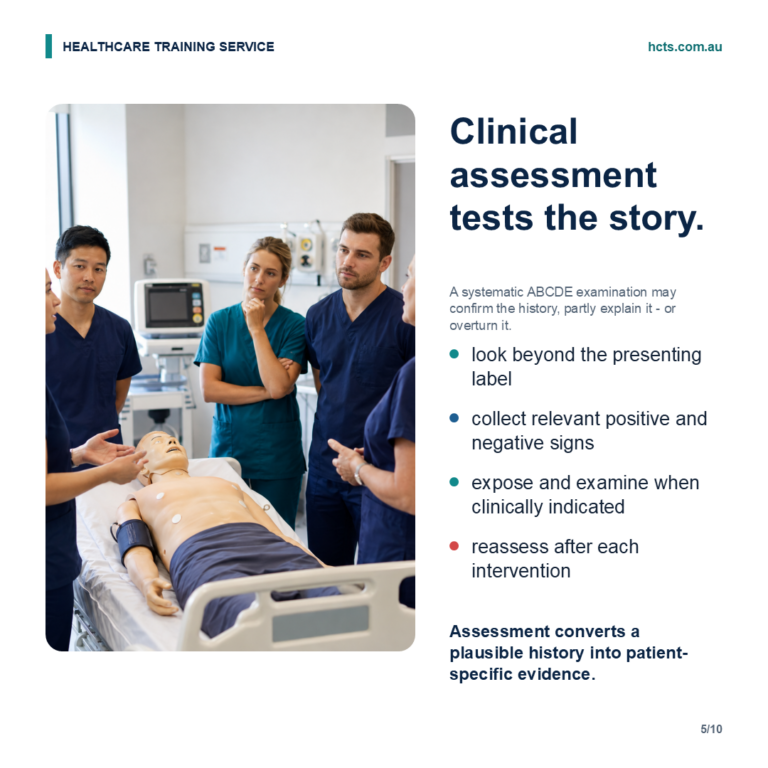
Clinical assessment converts a plausible story into current, patient-specific evidence. A systematic ABCDE examination provides structure, but the clinician must still decide which findings matter, which expected signs are absent and what requires further exposure, palpation, auscultation, measurement or investigation.
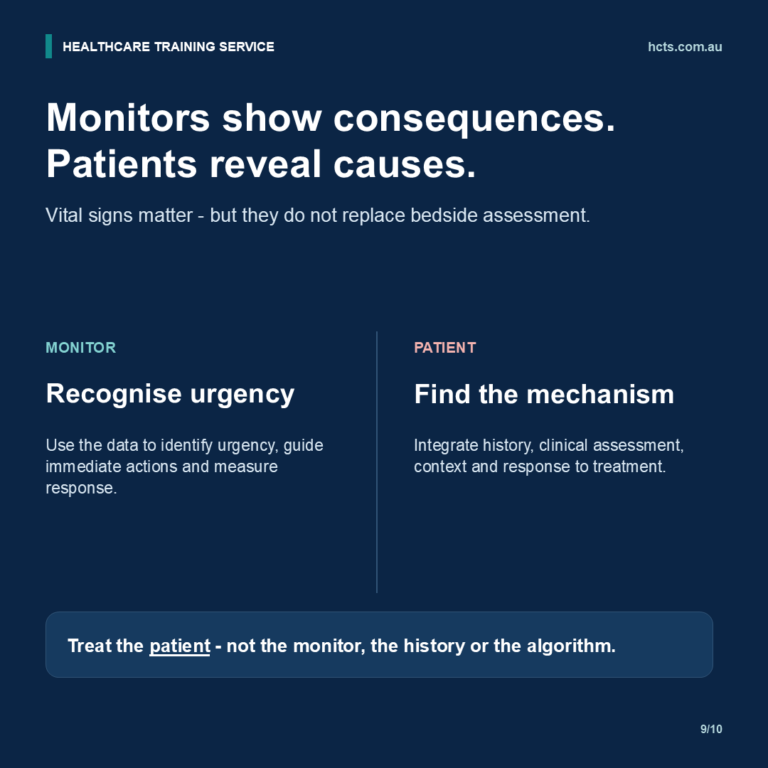
Monitor data are essential for recognising urgency and measuring change. They show consequences such as tachycardia, hypoxaemia, hypotension or an abnormal rhythm. They do not necessarily identify the mechanism. The same vital-sign pattern can arise from very different causes and require very different treatment.
A 2018 review of diagnostic error reported that inadequate history taking and physical examination account for a substantial proportion of diagnostic errors. Australia’s National Consensus Statement on acute physiological deterioration likewise emphasises prompt and reliable recognition and response. Recognition begins with observations, but a safe response requires assessment of the patient behind them.
Clinical implication Use the monitor to recognise urgency and measure response. Use clinical assessment to determine what may be producing the abnormality.
Patient assessment and clinical reasoning
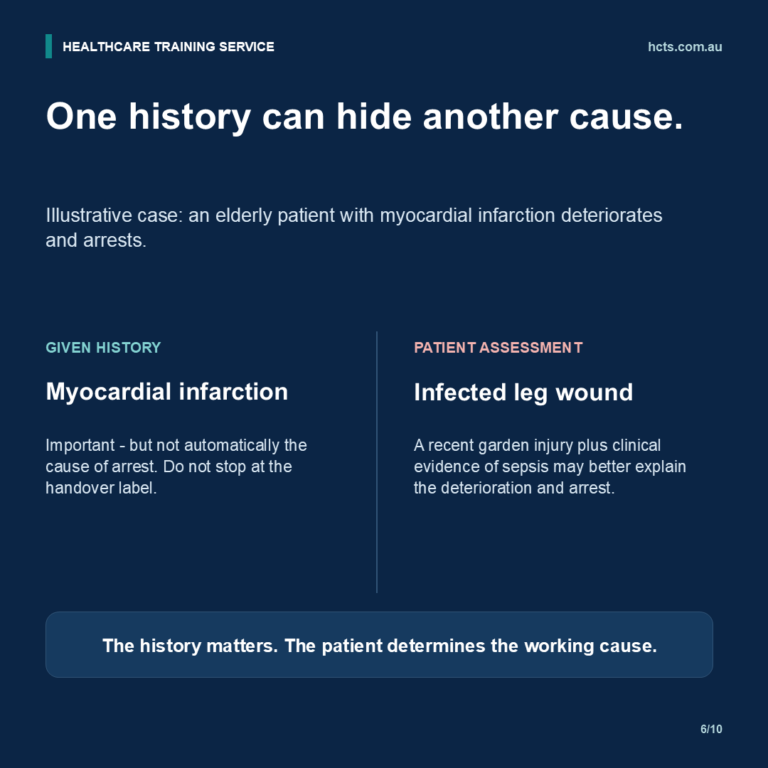
Consider an elderly patient admitted with a myocardial infarction who later deteriorates and arrests. The cardiac history is highly relevant, and a coronary cause must remain in the differential. It should not end the assessment.
Exposure and examination reveal an infected leg wound after a recent gardening injury. If the wider assessment also shows clinical evidence consistent with sepsis, sepsis may better explain the deterioration, or it may be contributing alongside the cardiac disease. The wound alone does not prove sepsis, and the myocardial infarction cannot simply be dismissed. The point is that the handover label does not determine the cause.
As new evidence appears, the clinician must re-rank the possibilities and direct treatment towards the cause best supported by the whole clinical picture.
Clinical lesson The history creates a hypothesis. Clinical assessment tests it.
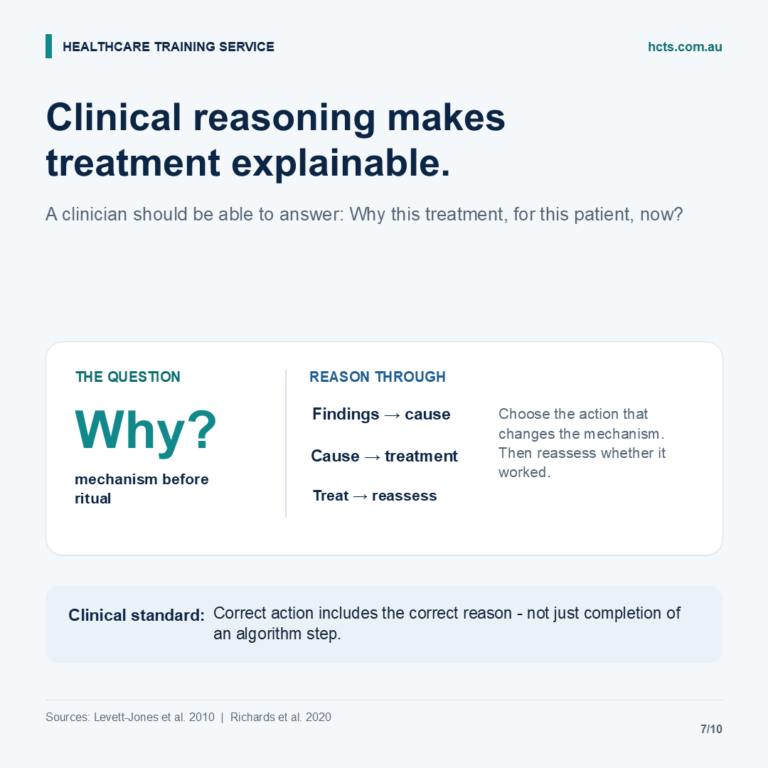
Clinical reasoning asks why a particular intervention is required for this patient at this time. It connects the assessment findings to a physiological mechanism, selects treatment that can change that mechanism and identifies what response should follow.
A correct action performed for the wrong reason is fragile knowledge. It may work in a familiar scenario but fail when the presentation changes. A clinician who understands the mechanism can adapt when the first intervention fails, the equipment behaves differently or more than one pathology is present.
The reasoning sequence is practical:
The central question Why this treatment, for this patient, now?
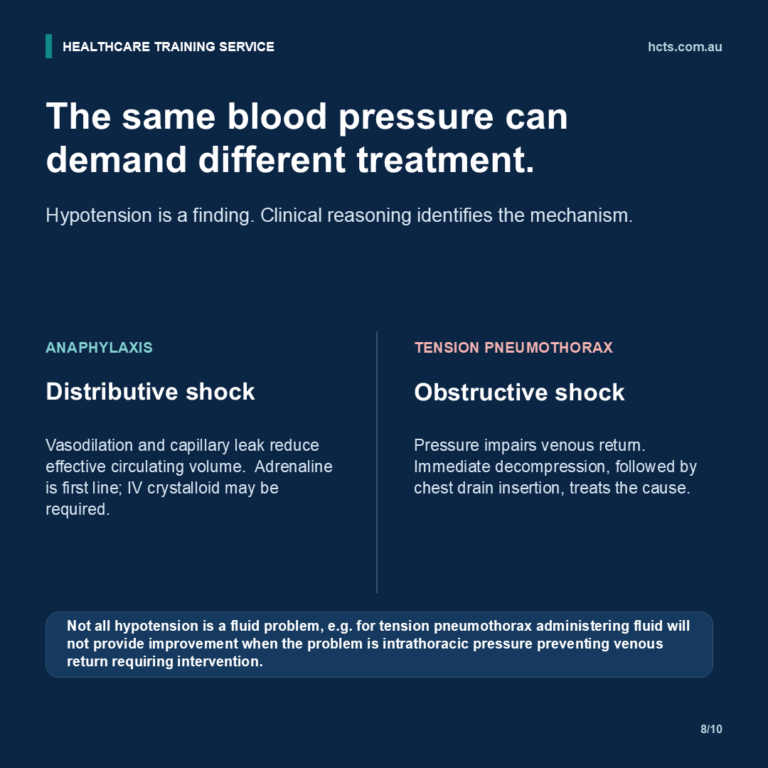
Hypotension is a finding, not a diagnosis. Clinical reasoning identifies the mechanism producing it.
Anaphylaxis Vasodilation and capillary leak reduce effective circulating volume. Intramuscular adrenaline is first-line treatment, and intravenous crystalloid may be required when hypotension persists. The clinician should understand what each intervention is intended to correct.
Tension pneumothorax Rising intrathoracic pressure impairs venous return and produces obstructive shock. In cardiac arrest with suspected tension pneumothorax, ANZCOR advises immediate chest decompression followed by chest-drain insertion. Fluid does not relieve intrathoracic pressure and must not delay treatment of the obstruction.
The distinction must not become another rigid rule. A patient with trauma may also have haemorrhage or genuine hypovolaemia and require appropriate blood or fluid resuscitation. Persistent hypotension after needle decompression requires urgent reassessment for incomplete decompression, recurrence or another cause, together with definitive chest drainage according to local protocol and available expertise.
Clinical lesson Similar numbers do not guarantee the same mechanism. Treat the cause supported by the assessment, then evaluate the response.
Algorithms, checklists and the 4 Hs and 4 Ts are valuable cognitive aids. ANZCOR describes the 4 Hs and 4 Ts as a simple reminder of conditions that may precipitate cardiac arrest or reduce the chance of successful resuscitation. It also states that the circumstances, history, precipitating events and clinical examination may help determine the cause, and that interventions should be based on the presumed aetiology.
That distinction matters. The list prompts a search; it does not perform the assessment. The algorithm organises immediate priorities; it does not decide which reversible cause is present in this patient.
Critical thinking must not delay time-critical care. During cardiac arrest, high-quality CPR, indicated defibrillation and other immediate interventions proceed while the team searches for and treats reversible causes. Good reasoning makes priorities clearer. It does not create a pause for discussion when action is required.
Treatment is also a clinical test. The clinician should know what improvement to expect if the intervention addresses the presumed mechanism. No response, an unexpected response or further deterioration should trigger renewed assessment.
Was the intervention delivered correctly? Has the physiology changed? Is the explanation wrong or incomplete? Is another pathology present? Is escalation required?
Reassessment prevents an ineffective treatment from continuing simply because it appears next in a familiar sequence.
HCTS embeds the three pillars throughout ALS and PALS education. Candidates use algorithms accurately and explain the findings, mechanism and intended effect that support their decisions.
Clinicians are not expected to provide a running explanation when urgent action is required. Reasoning can be made visible during preparation and structured debriefing without delaying care.
Useful debriefing questions include:
Repeated practice connects recognition, assessment, action and reassessment under pressure. Follow the algorithm, understand the mechanism and change course when the patient does not respond as expected.
History creates a hypothesis. Clinical assessment tests it. Clinical reasoning connects the findings to treatment. Think beyond the label. Assess the patient. Treat the mechanism. Reassess. Treat the patient, not the monitor, the history or the algorithm.
HealthCare Training Service provides Advanced Life Support and Paediatric Advanced Life Support education designed to build practical competence, clinical reasoning and confidence under pressure.
Website buttons:
Educational note: This article is intended for healthcare education and should be read alongside current resuscitation guidelines, organisational policies and local clinical governance.
1. Tanner CA. Thinking like a nurse: a research-based model of clinical judgment in nursing. J Nurs Educ. 2006;45(6):204211. doi:10.3928/01484834-20060601-04. View source
2. Levett-Jones T, Hoffman K, Dempsey J, et al. The ‘five rights’ of clinical reasoning: an educational model to enhance nursing students’ ability to identify and manage clinically ‘at risk’ patients. Nurse Educ Today. 2010;30(6):515-520. doi:10.1016/j.nedt.2009.10.020.View source
3. Richards JB, Hayes MM, Schwartzstein RM. Teaching Clinical Reasoning and Critical Thinking: From Cognitive Theory to Practical Application. Chest. 2020;158(4):1617-1628. doi:10.1016/j.chest.2020.05.525. View source
4. Nendaz M, Perrier A. Diagnostic errors and flaws in clinical reasoning: mechanisms and prevention in practice. Swiss Med Wkly. 2012;142:w13706. doi:10.4414/smw.2012.13706. View source
5. Clark BW, Derakhshan A, Desai SV. Diagnostic Errors and the Bedside Clinical Examination. Med Clin North Am. 2018;102(3):453-464. doi:10.1016/j.mcna.2017.12.007. View source
6. Australian Commission on Safety and Quality in Health Care. National Consensus Statement: Essential elements for recognising and responding to acute physiological deterioration. Third edition. 2021; glossary updated September 2026. Accessed 1 October 2026. View source
7. Australian and New Zealand Committee on Resuscitation. Guideline 11.2 – Protocols for Adult Advanced Life Support. Accessed 1 October 2026. View source
8. Australian and New Zealand Committee on Resuscitation. Guideline 11.10 – Resuscitation in Special Circumstances. Approved July 2026. Accessed 1 October 2026. View source
The Three Pillars of a Good Clinician is an HCTS teaching framework developed by Denise Airey. The references above support the component skills and their integration in clinical judgement; they do not establish the phrase as a separately validated or universally accepted model.